01
Perplace
editable 3d cities, buildings and interiors where every object is data an agent can use
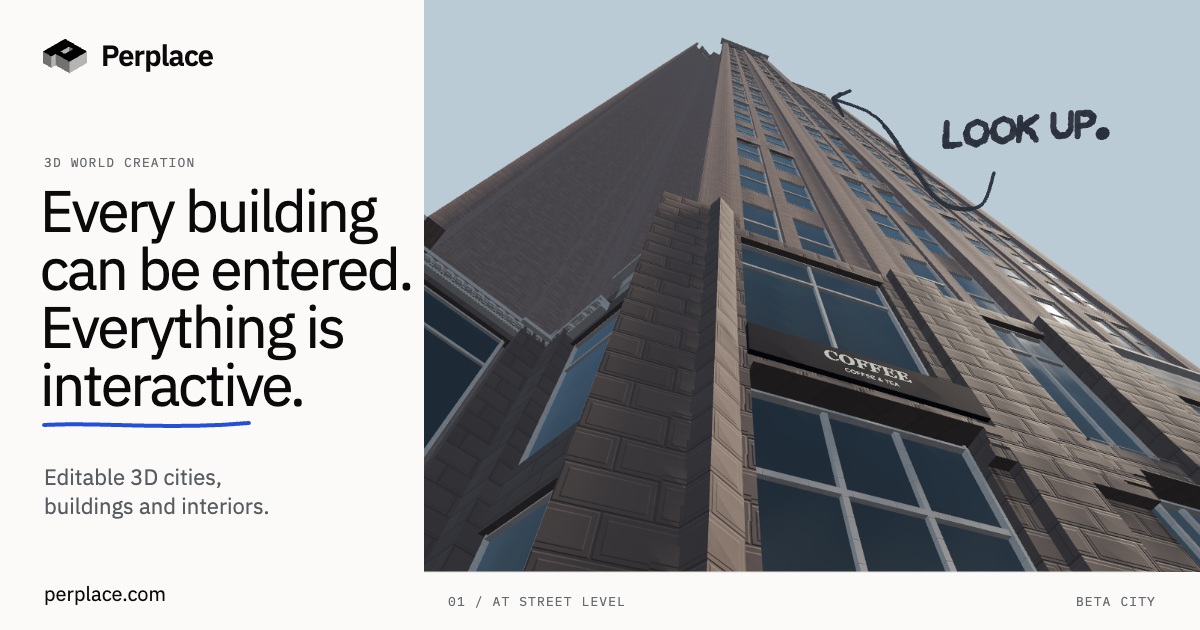
Perplace is the most important project I work on today. It is a 3D world creation tool: it generates editable 3D cities, buildings and interiors. You start with a real place, a reference or an idea, and you get one connected world, from the streets to the rooms inside, where every building can be entered and the objects keep their meaning as data.
- editable 3D cities, buildings and interiors
- cities → buildings → interiors as one connected world
- private beta with paid per-project pilots
- public changelog: 54 shipped days from 24 Jul 2026
World as data
The core idea of Perplace is that the world is data, not only a picture. A chair belongs to a room and a door connects two spaces, and those relationships live alongside the geometry. Every world is one tree: a city holds buildings, a building holds floors, a floor holds rooms, a room holds objects, each with a stable id and typed fields, so the armchair in the living room on the ground floor of the corner building is a path, not a search. Each object records its uses, articulation, mobility with an approximate mass, collision, material, state and access points, and names and uses are bilingual.
Agents and navigation
In Perplace an agent can use the world directly. The demo agent walks, sits, lies down, opens and closes doors and windows, and picks up and puts down objects, all from the world data with no hand-placed waypoints. The data guarantees a few rules: every usable object has an access point outside all footprints, footprints are never ignored, and if there is no free path the agent stays put and says so instead of walking through furniture; doors keep the state the last action left them in. On day 52 of the build log a floor was exported to USD and opened in Newton.
Design, build, review loop
Perplace combines AI design, procedural construction and visual review in one automated cycle: design, build, evaluate, refine. An AI architect directs a building through explicit orders like facade composition, cornice, arches or a roof with a water tank; procedural tools build each order; and an independent visual critique accepts or rejects it. The visual judge renders a building from chosen viewpoints and scores it with a deterministic signal before any model opinion. The model captures intent but the geometry stays deterministic, so a design request alone rebuilds a building exactly, and a rejected facade request degrades by cell or by face instead of losing the building.
Real places and local edits
A Perplace world can start from a real area, where streets, footprints and heights come from open data, or from a place that does not exist. Interiors are always generated, so the rooms and objects are never a copy of a real home or office. Editing is local: you can ask to turn a building into an old brick warehouse or a modern glass office and only the selected element changes, while the other buildings, the streets and the materials you did not touch stay exactly as they are.